
Exercises – Short Day#
Exercise 1: Degrees vs radians#
In this exercise we wish to brush up on how angles measured in degrees can be converted to radians and vice versa.
Question a#
State the angles \(30, 60, 120, 135\) and \(300\) degrees in radians.
Answer
\(\frac{\pi}{6}\), \(\frac{\pi}{3}\), \(\frac{2\pi}{3}\), \(\frac{3\pi}{4}\), \(\frac{5\pi}{3}\). In general, an angle of \(x\) degrees corresponds to \(x \pi / 180\) (radians).
Question b#
Sketch a unit circle in an \((x,y)\) coordinate system centred at the origin. Draw points on the circle that correspond to each of the arc lengths
Which angle measures in degrees do they correspond to?
Answer
\(180\), \(60\), \(330\), \(330\), \(105\), \(90\), \(315\). In general, an arc length of \(x\) (radians) corresponds to \(180x/\pi\) degrees if \(x \in [0,2\pi[\). If \(x \not\in [0,2\pi[\), then we should first add a multiple of \(2\pi\) so the result lies in the interval \([0,2\pi[\).
Exercise 2: Revision of cosine and sine#
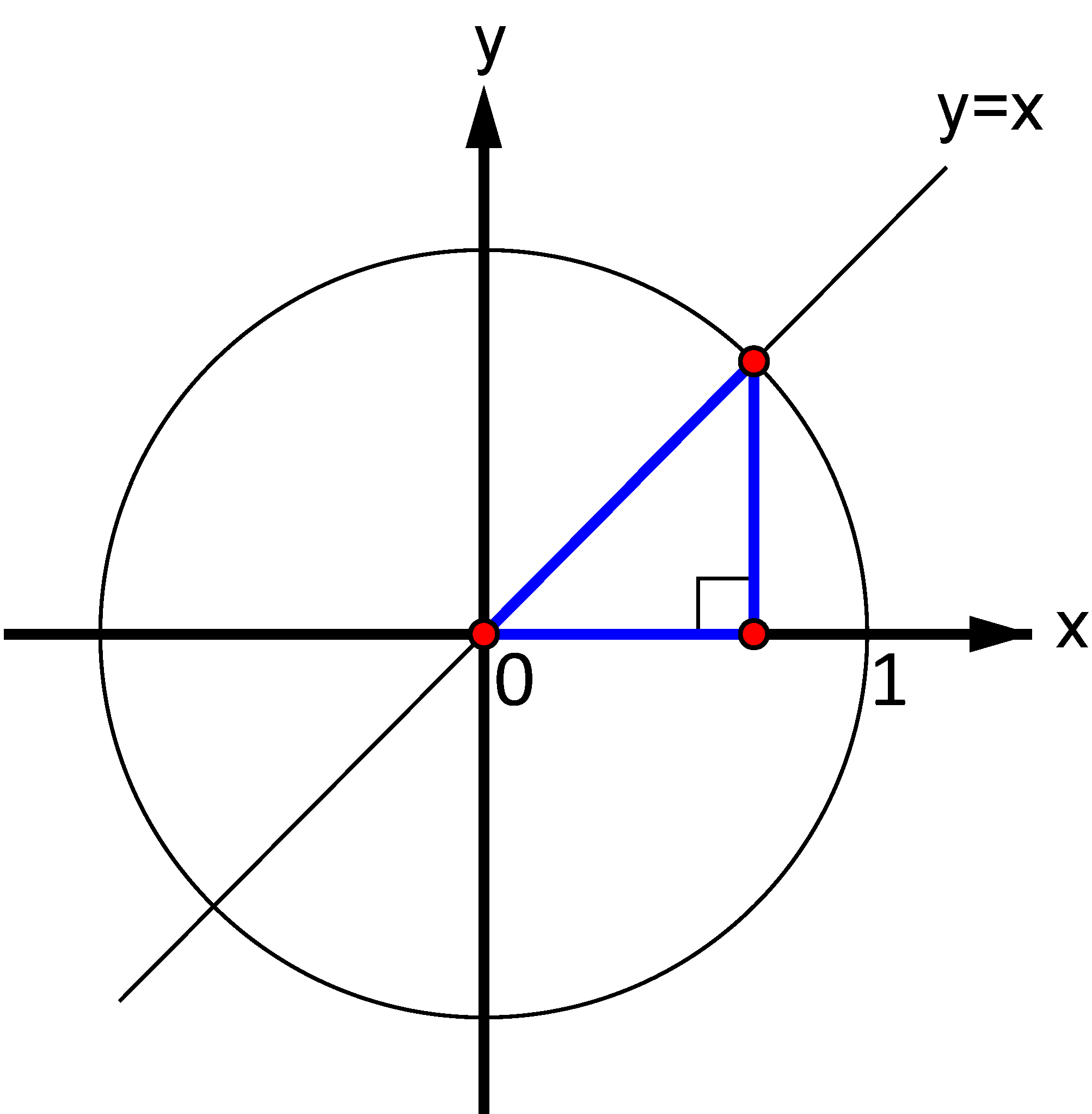
Question a#
Use the figure above (the blue triangle) to determine geometrically the exact values of \(\displaystyle{\cos\left(\frac{\pi}{4}\right)}\) and \(\displaystyle{\sin\left(\frac{\pi}{4}\right)}\).
Hint
Remember that the Pythagorean theorem implies \(\cos^2(x)+\sin^2(x)=1\) for all real numbers \(x\) - this is sometimes known as the “dummy rule”.
Answer
Both are \(\frac{\sqrt{2}}{2}\).
Question b#
Use symmetry considerations to determine the numbers
Answer
\((-\frac{\sqrt{2}}{2},\frac{\sqrt{2}}{2}),(-\frac{\sqrt{2}}{2},-\frac{\sqrt{2}}{2}),(\frac{\sqrt{2}}{2}, -\frac{\sqrt{2}}{2}),(\frac{\sqrt{2}}{2}, -\frac{\sqrt{2}}{2}),(-\frac{\sqrt{2}}{2}, -\frac{\sqrt{2}}{2}), (-\frac{\sqrt{2}}{2}, \frac{\sqrt{2}}{2}),(\frac{\sqrt{2}}{2}, \frac{\sqrt{2}}{2}).\)
Question c#
We are informed that \(\displaystyle{\cos\left(\frac{\pi}{6}\right)}=\frac{\sqrt 3}{2}\) and \(\displaystyle{\sin\left(\frac{\pi}{6}\right)}=\frac{1}{2}\). Draw the point
on a unit circle, and use symmetry considerations to determine the numbers
Hint
Note: in Appendix 1 in the textbook, found right after the last chapter, you can find a unit circle along with cosine and sine values of several commonly used and “nice-looking” angles.
Exercise 3: The arcus functions#
In this exercise we consider the inverse trigonometric functions \(\mathrm{arccos}\), \(\mathrm{arcsin}\) and \(\mathrm{arctan}\). If you need a refresher, or you’d like to view the graphs of these functions, have a look at Section 2.3 in the textbook (in particular the subsection “The Inverse Trigonometric Functions”).
Question a#
Determine \(\displaystyle{\mathrm{arccos}\left(\frac{1}{2}\right),\,\mathrm{arcsin}\left(-\frac{\sqrt 3}{2}\right)}\) and \(\displaystyle{\mathrm{arctan}(-1)}\).
Answer
\(\frac{1}{3} \pi\), \(-\frac{1}{3} \pi\), \(-\frac{1}{4} \pi\).
Question b#
Let \(x \in \mathbb{R}\) and \(y \in [-1,1]\) be real numbers. Let \(P\) be the logical proposition \(\mathrm{arccos}(y)=x\) and \(Q\) the logical proposition \(y=\cos(x)\). Show that \(P \Rightarrow Q\) is true whereas \(Q \Rightarrow P\) is not necessarily true.
Hint
Regarding \(P \Rightarrow Q\), what happens if you apply \(\cos\) to both sides of the equation in \(P\)?
Regarding \(Q \Rightarrow P\), can you find an \(x \in \mathbb{R}\) and a \(y \in [-1,1]\) such that \(Q\) is true while \(P\) isn’t?
Exercise 4: Trigonometric equations#
For this exercise, use the inverse trigonometric functions from Exercise 3.
Question a#
We are given the sets \(A=\left[\,0\,,\,2\pi\,\right]\) and \(B=\left[\,-\pi\,,\,\pi\,\right]\).
Solve the equation \(\displaystyle{\cos(x)=\frac{1}{2}}\) within each of the sets \(A\), \(B\) and \(\Bbb R\).
Hint
A solution to the equation can be stated immediately based on Exercise 3a, since we found in Exercise 3b that \(\mathrm{arccos}(y)=x\) implies \(y=\cos(x)\). Now find all solutions in \(\mathbb{R}\) by first drawing a sketch of the graph of the \(\cos\) function.
Answer
In \(A\) the solutions are \(\frac{\pi}{3}\) and \(\frac{5\pi}{3}\).
In \(B\) the solutions are \(\frac{-\pi}{3}\) and \(\frac{\pi}{3}\).
In \(\mathbb{R}\) the solutions are \(\frac{-\pi}{3}+p\cdot 2\pi\) and \(\frac{\pi}{3}+p\cdot 2\pi\), where \(p \in \Bbb Z\).
Question b#
Solve the equation \(\displaystyle{\sin(x)=-\frac{\sqrt 3}{2}}\) within each of the sets \(A\), \(B\) and \(\Bbb R\).
Answer
Within \(A\) the solutions are \(\frac{4\pi}{3}\) and \(\frac{5\pi}{3}\).
Within \(B\) the solutions are \(\frac{-2\pi}{3}\) and \(-\frac{\pi}{3}\).
Within \(\mathbb R\) the solutions are \(\frac{4\pi}{3}+p\cdot 2\pi\) and \(\frac{5\pi}{3}+p\cdot 2\pi\), where \(p \in \Bbb Z\).
Exercise 5: Polar coordinates#
Question a#
We are given the numbers \(z_1=1+i\sqrt{3}\), \(z_2=-1+i\sqrt{3}\), \(z_3=-1-i\sqrt{3}\) and \(z_4=1-i\sqrt{3}\).
Draw \(z_1\), \(z_2\), \(z_3\) and \(z_4\) in the complex plane and state their rectangular coordinates.
Compute the moduli (also known as the absolute values) of \(z_1\), \(z_2\), \(z_3\) and \(z_4\). Conclude that the four numbers are located on a circle centred at \(0\). What is the radius of this circle?
Determine the principal arguments of \(z_1\), \(z_2\), \(z_3\) and \(z_4\) and state their polar coordinates.
Hint
For help with calculating the modulus and principal argument, see Theorem 4.3.1 (and also Figure 4.5) in the textbook.
Hint
\(\mathrm{arctan}(\sqrt{3})=\pi/3\), since \(\tan(\pi/3)=\frac{\sin(\pi/3)}{\cos(\pi/3)}=\frac{\sqrt{3}/2}{1/2}=\sqrt{3}\).
Answer
Partial answer:
\(z_1\): The rectangular coordinates of the number are \((1,\sqrt{3})\) while its polar coordinates are \((2,\pi/3)\).
\(z_2\): The rectangular coordinates of the number are \((-1,\sqrt{3})\) while its polar coordinates are \((2,2\pi/3)\).
\(z_3\): The rectangular coordinates of the number are \((-1,-\sqrt{3})\) while its polar coordinates are \((2,-2\pi/3)\).
\(z_4\): The rectangular coordinates of the number are \((1,-\sqrt{3})\) while its polar coordinates are \((2,-\pi/3)\).
Question b#
Someone wants to find the polar coordinates of the complex number \(-2+2i\). They use a pocket calculator and first type in:
which gives the output \(2\sqrt{2}\) as the absolute value. Then they type in:
which gives the output \(\,\displaystyle{-\frac {\pi}4}\).
This answer is wrong. Where is the error?
Question c#
Find the absolute value and the principal argument of the following complex number:
Answer
The absolute value is \(\frac{1}{3}\). The principal argument is \(\frac{2}{3} \pi\).
Question d#
We are given the following information about the moduli and arguments of three complex numbers \(z_1\), \(z_2\) and \(z_3\):
and
Note that we have not necessarily been given the principal argument of the numbers, just an argument.
Determine the principal arguments of the numbers.
Find the rectangular forms of the numbers.
Hint
The principal argument (or “the principal value of the argument”) of a complex number is the one argument that is located in the interval \(]-\pi,\pi]\). If the argument you have been given is not already in this interval, add a suitable multiple of \(2\pi\) so that the result lies in the interval \(]-\pi,\pi]\). Read the beginning of Section 4.3 of the textbook for more information.
Hint
For finding the rectangular form, Equation (4.4) in the textbook may be useful.
Answer
The principal arguments are \(\pi\), \(-2\pi/3\) and \(-3\pi/4\).
The numbers in rectangular form are \(-4\), \(-1-i \sqrt{3}\) and \(-3 \sqrt{2} - i 3 \sqrt{2}\).
Have you finished all the exercises?#
If it went too quickly and you are eager for more, then click here for some challenging optional extra exercises.